

















API (Application Programming Interface) adalah backbone dari modern web development, enabling communication antara frontend dan backend systems. Di tahun 2025, pemilihan antara REST dan GraphQL menjadi decision penting yang mempengaruhi architecture, performance, dan developer experience. Artikel ini akan memberikan comprehensive comparison dan best practices untuk API design modern.
Fundamental API Architecture
Apa itu API? API adalah set of rules dan protocols yang memungkinkan software applications berkomunikasi satu sama lain. Dalam web development, API menjadi jembatan antara client-side applications (frontend) dan server-side logic (backend).
Evolution dari API Design meliputi SOAP (Simple Object Access Protocol) dengan XML-based rigid structure, REST (Representational State Transfer) dengan HTTP-based resource-oriented, GraphQL dengan query language dan flexible data fetching, gRPC dengan high-performance protocol buffers, dan WebSocket dengan real-time bidirectional communication.
Modern API Requirements mencakup scalability dan performance, security dan authentication, documentation dan developer experience, versioning dan backward compatibility, serta monitoring dan analytics.
REST API Architecture Deep Dive
REST Principles: REST (Representational State Transfer) adalah architectural style yang menggunakan HTTP methods untuk operasi CRUD. Prinsip utama REST meliputi stateless dimana setiap request mengandung semua informasi yang dibutuhkan, client-server architecture dengan clear separation antara client dan server, cacheable responses untuk improve performance, uniform interface dengan consistent API contract, dan layered system dengan multiple layers tanpa client awareness.
REST API Structure menggunakan base URL seperti https://api.example.com/v1 dengan RESTful endpoints untuk User Management. GET /users untuk get all users, GET /users/{id} untuk get specific user, POST /users untuk create user dengan JSON body, PUT /users/{id} untuk update user, PATCH /users/{id} untuk partial update, DELETE /users/{id} untuk remove user, dan nested resources seperti GET /users/{id}/posts.
HTTP Methods dan Status Codes mapping mencakup GET untuk retrieve resource, POST untuk create resource, PUT untuk update entire resource, PATCH untuk partial update, dan DELETE untuk remove resource. Common status codes meliputi 200 OK untuk request successful, 201 Created untuk resource created successfully, 204 No Content untuk request successful dengan no content returned, 400 Bad Request untuk invalid request, 401 Unauthorized untuk authentication required, 403 Forbidden untuk access denied, 404 Not Found untuk resource not found, 422 Unprocessable Entity untuk validation failed, 500 Internal Server Error, 502 Bad Gateway, dan 503 Service Unavailable.
REST Response Format Standards menggunakan success response dengan single resource yang berisi data object dengan properties, meta object dengan timestamp dan version, error response format dengan error object yang berisi code, message, dan details array, serta collection response dengan pagination metadata dan links.
GraphQL Architecture Deep Dive
GraphQL Fundamentals: GraphQL adalah query language untuk APIs yang allows clients untuk request exactly the data yang mereka butuhkan. Fitur utama meliputi declarative data fetching dimana client specifies exactly what data they need, strong typing dimana schema defines API capabilities, single endpoint untuk semua queries, dan introspection untuk self-documenting API.
GraphQL Schema Definition menggunakan GraphQL schema language dengan type definitions. User type dengan ID, name, email, age, posts connection, dan timestamps. Post type dengan ID, title, content, published flag, author relationship, comments connection, dan timestamps. Connection types untuk pagination dengan edges dan pageInfo. Input types untuk mutations dengan UserInput dan PostInput. Root Query type dengan user queries, post queries, dan search functionality. Root Mutation type dengan user mutations, post mutations, dan comment mutations. Root Subscription type untuk real-time updates dengan postCreated, postUpdated, dan commentAdded. Custom scalar types seperti DateTime dan Upload.
GraphQL Query Examples meliputi basic query untuk user dengan posts, complex query dengan fragments untuk reusable field selections, query dengan alias dan arguments untuk field naming, dan variables untuk dynamic parameter passing.
GraphQL Mutations meliputi create user mutation dengan input type, complex mutation dengan multiple operations, dan variables untuk mutation parameters.
REST vs GraphQL Comparison
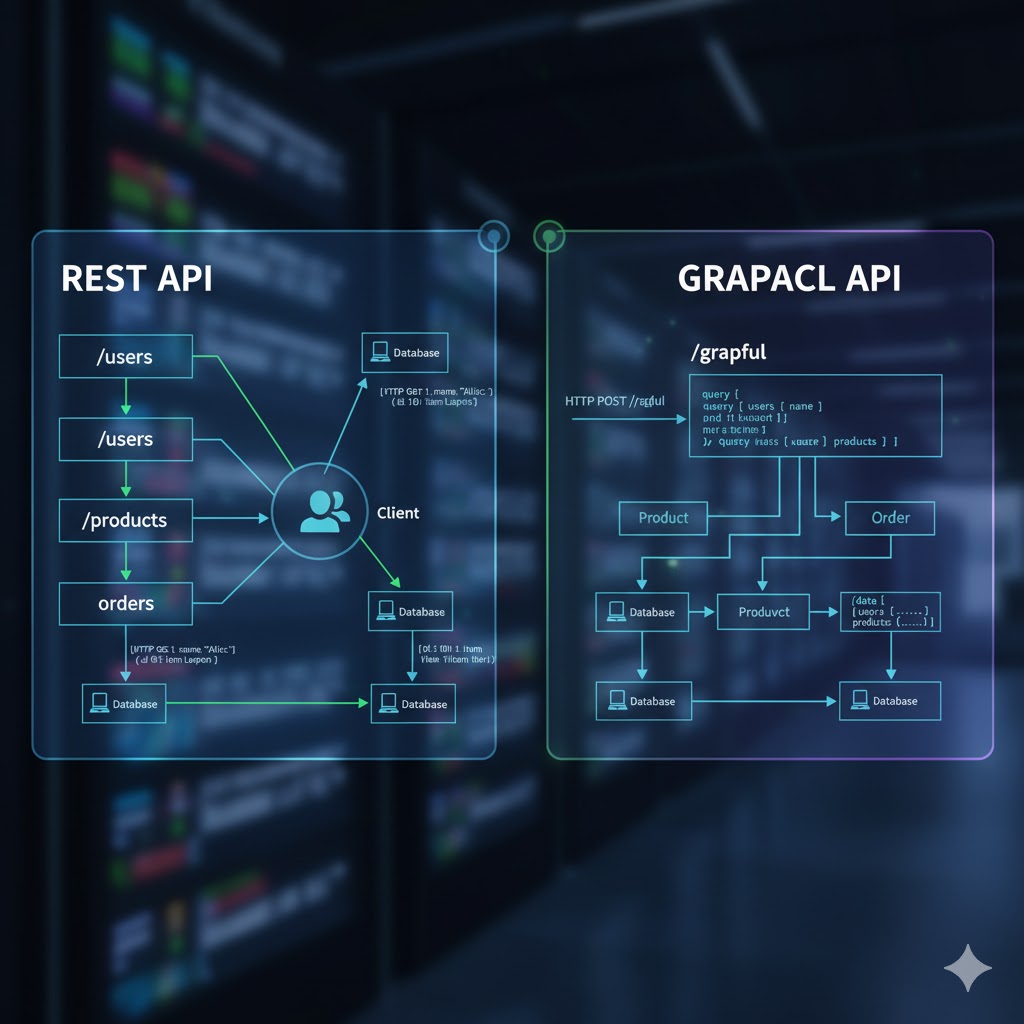
Data Fetching Efficiency: REST memerlukan multiple requests untuk related data seperti user posts dan comments, sedangkan GraphQL menggunakan single request untuk semua data yang dibutuhkan. REST sering mengalami over-fetching dimana client mendapatkan data yang tidak dibutuhkan, dan under-fetching dimana multiple requests diperlukan untuk related data. GraphQL menyelesaikan masalah ini dengan exact data fetching dan single request untuk related data.
Over-fetching dan Under-fetching: REST problems meliputi over-fetching dimana GET /users/1 mengembalikan semua user fields ketika client hanya butuh name dan email, dan under-fetching dimana multiple requests diperlukan untuk posts, comments, dan followers. GraphQL solutions meliputi exact data fetching dimana client hanya request fields yang dibutuhkan, dan single request untuk related data dengan nested queries.
Versioning Strategy: REST versioning menggunakan URL versioning seperti /api/v1/users dan /api/v2/users untuk breaking changes, sedangkan GraphQL evolution tanpa breaking changes menggunakan extend type untuk new fields dan deprecated directive untuk old fields.
Performance Considerations
Caching Strategies: REST caching menggunakan HTTP headers seperti Cache-Control, ETag, dan Last-Modified dengan client-side caching implementation. GraphQL caching menggunakan Apollo Client dengan InMemoryCache configuration, type policies untuk field merging, dan keyArgs untuk cache key generation.
Pagination Strategies: REST pagination menggunakan offset-based pagination dengan page dan limit parameters, response dengan pagination metadata, dan cursor-based pagination. GraphQL cursor-based pagination menggunakan connection types dengan edges, cursors, pageInfo, dan totalCount.
Security Best Practices
Authentication dan Authorization: REST security menggunakan JWT authentication middleware dengan token verification di routes. GraphQL security menggunakan authentication context dengan token verification di context, dan authorization dalam resolvers dengan role-based access control.
Rate Limiting dan DDoS Protection: REST rate limiting menggunakan express-rate-limit dengan windowMs dan max requests configuration. GraphQL rate limiting menggunakan custom middleware untuk request tracking dan IP-based limiting.
Documentation Strategy
REST Documentation dengan OpenAPI/Swagger menggunakan YAML specification dengan openapi version, info section, servers, paths dengan HTTP methods dan responses, dan components schemas untuk reusable types.
GraphQL Documentation dengan Schema dan Introspection menggunakan introspection queries untuk schema exploration, printSchema untuk documentation generation, dan Apollo Studio untuk enhanced documentation dan usage tracking.
When to Choose REST vs GraphQL
REST is Better When: simple resource-based applications, need untuk HTTP caching, standardization across teams, file upload/download requirements, dan public APIs dengan predictable structure.
GraphQL is Better When: complex data relationships, mobile applications dengan bandwidth limitations, multiple client types dengan different data needs, real-time updates requirements, dan rapid development iteration.
Hybrid Approach: REST untuk CRUD operations dan file uploads, GraphQL untuk complex queries dan real-time data, dan WebSocket untuk real-time updates dengan GraphQL subscriptions.
Future of API Development
Emerging Technologies meliputi gRPC untuk high-performance internal APIs, event-driven architectures dengan message queues, GraphQL Federation untuk microservices, dan API Gateway patterns untuk microservices.
AI-powered API Development meliputi automatic API documentation generation, intelligent request/response optimization, AI-assisted API design suggestions, dan automated testing generation.
Performance Optimizations meliputi edge computing untuk API deployment, CDN integration untuk global APIs, database query optimization, dan caching strategies evolution.
Kesimpulan
Pemilihan antara REST dan GraphQL tergantung pada specific use cases, team expertise, dan project requirements. REST provides simplicity dan standardized approach, sedangkan GraphQL menawarkan flexibility dan efficiency untuk complex applications.
Key considerations: Project complexity dimana simple CRUD lebih cocok dengan REST dan complex data lebih cocok dengan GraphQL, team expertise dimana REST lebih universally understood, client diversity dimana multiple client types lebih cocok dengan GraphQL, performance requirements dimana bandwidth-conscious applications lebih cocok dengan GraphQL, dan development speed dimana rapid iteration lebih cocok dengan GraphQL.
Best practices untuk API development: Design dengan user experience in mind, implement proper error handling, use appropriate authentication/authorization, provide comprehensive documentation, monitor performance dan usage patterns, dan plan for versioning dan evolution.
Investasi dalam proper API design akan payoff dalam long-term maintainability, developer productivity, dan system scalability. Choose the right tool untuk the job dan implement best practices consistently.